
Understanding Anxiety: Why It Happens and How to Break the Cycle

Anxiety has a way of showing up at the worst possible moments. In the middle of a busy shift. At 2am when you finally have a chance to rest. During a quiet moment that should feel peaceful but doesn't. You know you're not in danger, but your body hasn't gotten the message.
Why Does Anxiety Exist?
Anxiety developed as an evolutionary tool to protect us from dangerous situations. Our ancestors lived in an uncertain environment as hunters and gatherers and needed to know what was safe and what was not. Their survival depended on it. It would not have fared well if they walked up to a bear and expected a pleasant outcome. The ancestors that survived passed on their knowledge to others in their community and determined the most effective way to survive.
The brain developed the Fight, Flight, or Freeze response, which is part of the sympathetic nervous system. It acts as an alarm system to protect us and sometimes it starts working before we even realize it is happening.
If someone encounters a bear, they can:
Fight or confront the bear
Run away or hide
Freeze or play dead and hope they go away.
In today's society, We normally don't have to worry about coming face to face with an angry bear. Modern technology has made it so we can go to the grocery store rather than scavenge for wild berries. That doesn't mean we don't still have to deal with stressors on a regular basis. We have family dynamics, job stress, and live in an unpredictable world where things happen that we can't predict. We read about events in the news that make us concerned for the future.
What Happens in Your Brain During Anxiety
Your brain receives sensory information from the environment. The thalamus, which is located near the center of your brain, helps route four of your senses: sight, hearing, touch, and taste (smell takes a different path) for processing. It also detects pain and temperature.
These signals then travel to the cerebral cortex which is where the information is interpreted and decision making occurs. The hippocampus, which creates memories, is also important in this process.
The amygdala is the part of the brain that activates the alarm if it senses danger. Sometimes you don’t know why it happens and it isn't always rational. When the Amygdala sounds the alarm, the hypothalymus responds by releasing cortisol ("the stress hormone") and epinephrine (adrenaline).
These cause symptoms of anxiety such as:
Increased Heart rate or blood pressure - the heart is working hard to deliver oxygen and nutrients to muscles to be efficient
Digestion slows down - the body diverts its resources to the muscles
Sweating - This acts to keep the body cool and avoid overheating.
Muscle tension or shaking - the body is activated for a quick escape
You may also experience sharper sight and hearing to better monitor your surroundings.
In the short term, this activation is not dangerous to the body even though it feels miserable. If the threat is not a danger, the anxiety will go away on its own, normally within 20 minutes.
How Anxiety Gets Stuck in a Loop
Anxiety can get out of control when the brain gets stuck in a loop.
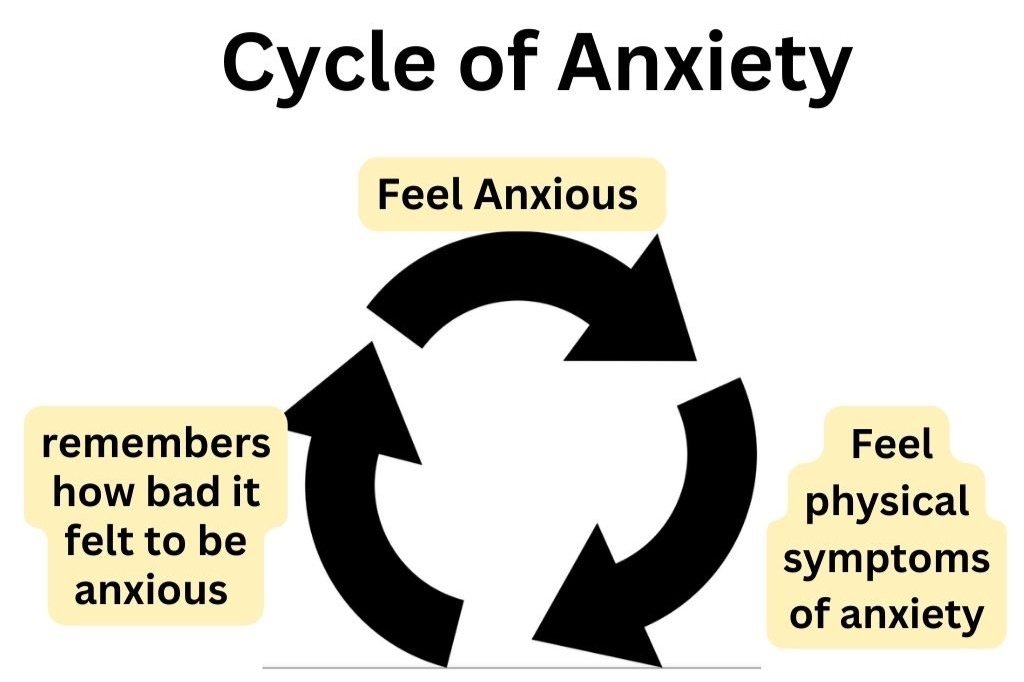
Consider a nurse who starts feeling her heart race during a particularly overwhelming shift. The next time she walks into work, she notices the anxiety before she's even clocked in, her body already bracing for what's ahead. She starts leaving as quickly as possible at the end of each shift, avoiding the break room, skipping team meetings. The relief is temporary. The anxiety grows.
This pattern shows up differently for everyone. A teacher dreading Monday mornings, a caregiver who can't relax even on days off, a therapist who finds it hard to be present at home. The trigger changes. The cycle stays the same.
Often getting stuck in the loop can lead to avoiding the things that make us anxious. Avoidance can work in the short term because it keeps you in your comfort zone since you don't have to experience the negative feelings. The problem with avoiding anxiety is that it can make it worse over time. While avoiding anxiety-provoking places, you may also avoid accomplishing important tasks that can help you grow as a person. It can lead to lower self-esteem, lack of confidence, or hopelessness.
This is one way that anxiety disorders and phobias develop. Maybe someone experienced a dog growling at them and caused them to feel anxious. The next time they see the dog, they might feel fearful of the dog, dogs that look similar, or even dogs in general. This is because the nervous system has learned from experience that the dog could be dangerous and this feeling of fear is reinforced by avoidance.
How to Break the Anxiety Cycle
If this cycle sounds familiar, you don't have to keep pushing through it alone. Anxiety therapy can help you understand what's driving the pattern, build practical tools for when it spikes, and gradually learn to relate to anxiety differently, so it no longer has to run the show.
Approaches like EMDR and Brainspotting can also help your nervous system process what's underneath the anxiety, reaching what talk therapy alone sometimes can't.
If you're ready to feel less stuck and more like yourself again, I'd love to help. Reach out here to get started.
-
Kenwood, M. M., Kalin, N. H., & Barbas, H. (2022). The prefrontal cortex, pathological anxiety, and anxiety disorders. Neuropsychopharmacology : official publication of the American College of Neuropsychopharmacology, 47(1), 260–275. https://doi.org/10.1038/s41386-021-01109-z
Price J. S. (2003). Evolutionary aspects of anxiety disorders. Dialogues in clinical neuroscience, 5(3), 223–236. https://doi.org/10.31887/DCNS.2003.5.3/jprice
Sah P. (2017). Fear, Anxiety, and the Amygdala. Neuron, 96(1), 1–2. https://doi.org/10.1016/j.neuron.2017.09.013
Torrico, T. J., & Munakomi, S. (2022). Neuroanatomy, Thalamus. In StatPearls. StatPearls Publishing.
